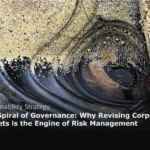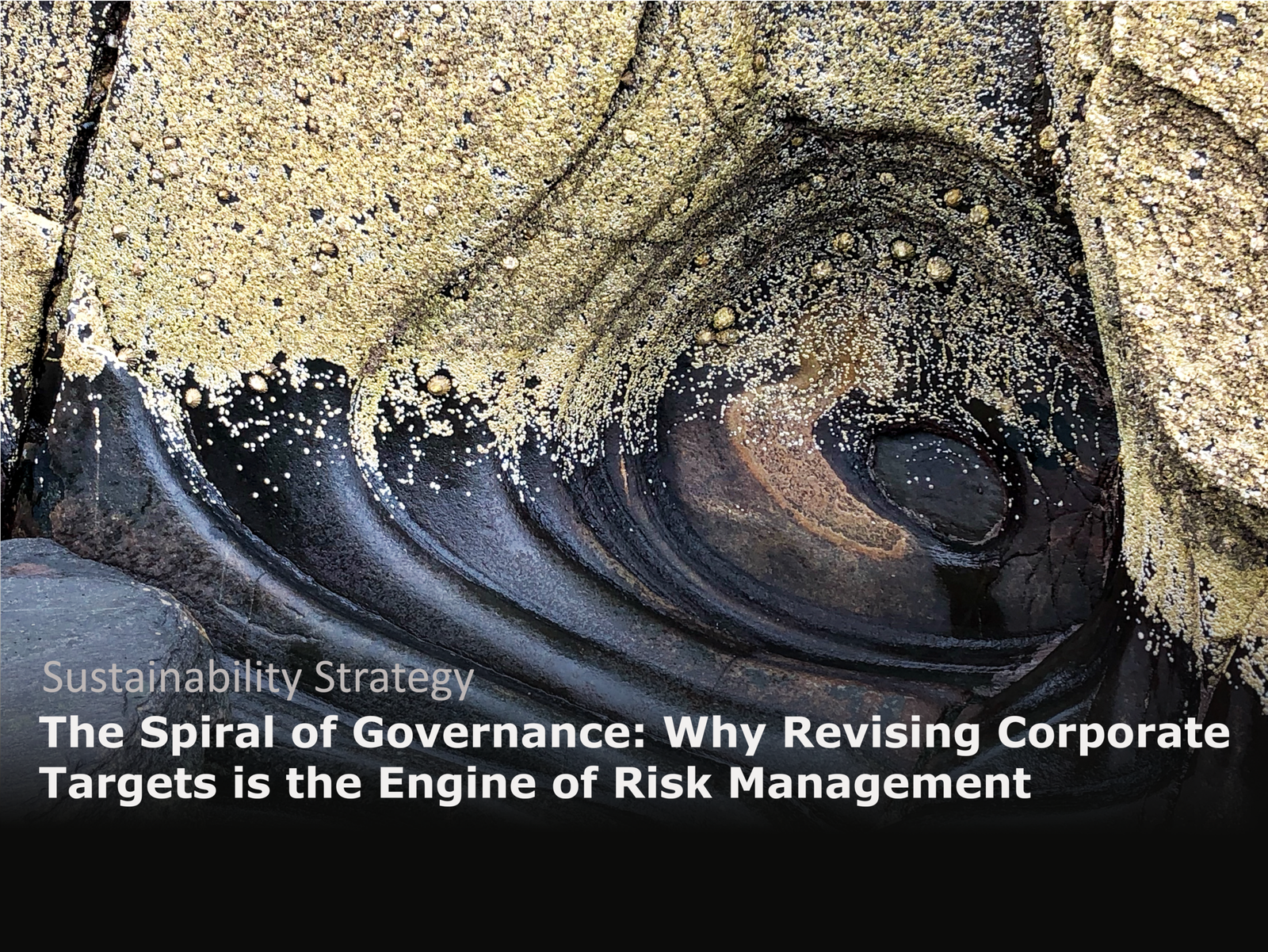
I found this natural spiral carved into the rock face on a beach in Scotland. It is the result of years of continuous, unyielding bombardment by the tide, currents, and stones shaping the rock into a deliberate, self-reinforcing loop. It struck me as a powerful metaphor for the continuous, spiralling nature of corporate governance in action, responding to the constant bombardment of macro- and microeconomic forces.
We have recently seen major corporate entities like Burberry, Shell, and Morrisons announce adjustments to their multi-decade decarbonisation timelines, changes that critics are quick to call out as a retreat. Looking at this through a governance lens, however, we see a more complex picture: a structural mismatch between long-term strategy and short-term capital deployment that is fundamentally a risk-management issue, but which also demonstrates how governance can directly abut strategy.
Going forward, should a properly applied fiduciary duty constrain the strategic choice to deprioritise decarbonisation capex when businesses are under pressure?
The Myth of the Linear Strategy
In a corporate decarbonisation strategy, it is widely considered best practice for firms to set science-based targets approved by the SBTi. Traditionally, these targets have been treated linearly: you set a target for 2050 and draw a straight line to it, consistent with a rigid net-zero formula. But this creates an inherent problem for businesses, as they do not operate in a geopolitical and microeconomic vacuum.
The psychologist Carl Jung famously observed that human and organisational growth is rarely linear. Instead, he used the concept of circumambulation: a spiral where you continually circle back to the same core problems, but each time you return, you do so with a deeper layer of awareness, data, and insight.
When a board revises a climate target today, they are not discovering a new problem; they are looping back to an old commitment now armed with verified Scope 3 numbers and updated technological know-how.
Governance is the Engine, Not the Dashboard
As independent director Hiro Mizuno accurately summarised: Environmental and Social factors are outcomes… Governance is the means to ensure the company looks after them over the long term.
Governance is the institutional engine that informs decision-making. If a board blindly adheres to an uncosted 2040 target despite shifting market realities, that isn’t good governance; it is a failure of fiduciary duty. Conversely, adjusting a timeline to protect near-term capital allocation while maintaining a long-term destination is robust risk management in practice.
Furthermore, when companies like Burberry cite a sudden “greater understanding” to explain a shift in targets, it strongly suggests that data paucity was originally ignored as an execution risk, and the unreliability of emissions data was missing from the risk register. This is a structural governance failure corrected by investing in systems, processes, and deeper supply chain engagement.
Governance is not a static goal or target; it is a mechanism to inform good decision-making by ensuring the board gets the right information with the corresponding accountability structures. With good governance, boards can act in full knowledge, weighing short-term survival against long-term risk, thereby turning basic compliance into effective strategy.
The Governance and Strategy Challenge Ahead
The data highlights a glaring execution gap across sectors:
- According to the LSE’s Transition Pathway Initiative, 87% of major boards have formal climate oversight.
- Yet, fewer than 0.5% have successfully aligned their capital expenditure with those long-term pathways.
As emissions data and calculation methodologies continue to mature, leadership teams face a harsh commercial reality: achieving these timelines requires fundamental changes to business models and major capital expenditure.
Even though the SBTi targets remain linear and static, the decision-making should not be. It requires a continuous, iterative cycle of data collection, risk assessment, and pragmatic capital allocation choices.
Three Questions for the Boardroom
To ensure your governance engine is a self-reinforcing spiral of resilience, leadership teams should be asking:
- The Capex Alignment Test: How is our board systematically auditing the friction between our multi-decade sustainability commitments and our active 3-year capital expenditure model?
- The Information Architecture Test: Does our reporting structure treat operational data as a retrospective compliance metric, or are we actively using it to forecast execution risk?
- The Risk Pricing Test: When we choose to delay a long-term milestone to preserve near-term margins, are we explicitly pricing the deferred risks – such as asset stranding or regulatory penalties – back into our corporate risk register?
Like the relentless tides on a Scottish beach, macro-pressures never stop testing the resilience of the corporate strategy. The board’s role is to build a governance framework that supports dynamic decision-making and strengthens business resilience. This is circumambulation in practice: a complex system that continually circles back to core challenges, but returns to them with deeper awareness, data, and insight to steer the organisation forward.